
While owning a pool in Arizona offers a necessary escape from the heat, monsoon season introduces a complex challenge for homeowners. Dust and intense rain can quickly turn a sparkling clear oasis into a green mess. How do you keep your swimming pool safe and clear when desert storms strike? By following a proactive maintenance routine, you can prevent chemical imbalances and equipment failure during the Valley’s toughest weather months.
If you’ve owned a pool in Queen Creek, Gilbert, Chandler, or Mesa for more than one summer, you know what a monsoon can do overnight. One storm rolls through and suddenly your pool is full of debris, the water has gone cloudy, and your chemistry is completely off.
Monsoon season runs roughly from mid-June through September in the Valley. For pool owners, that means three months of unpredictable storms that can undo a week of clean water in a matter of hours. Here’s what you need to know to stay ahead of it.
Key Takeaways
- Arizona monsoons cause rapid pH shifts and phosphate spikes that lead to algae growth.
- Preparation involves raising free chlorine levels and trimming nearby desert vegetation.
- Immediate post-storm maintenance, including skimming and water testing, is critical to avoid green water.
- Running your pool pump for 12-16 hours after a storm helps filter out fine desert dust.
How do Arizona monsoons affect your pool?
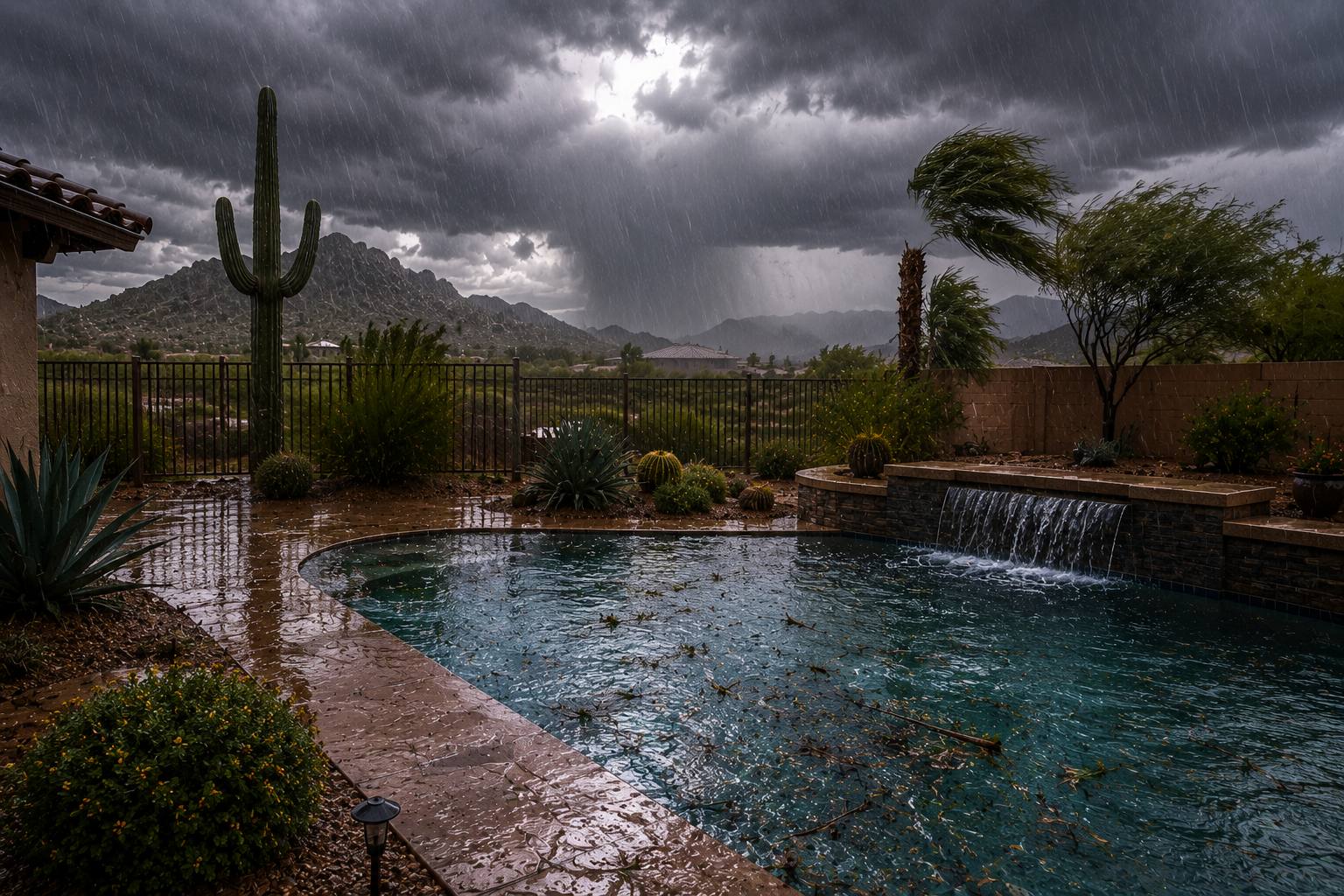
Arizona monsoons affect pools by introducing organic debris that spikes phosphate levels, dropping water pH with acidic rainfall, and washing in desert dust that can overwhelm filtration systems and trigger rapid algae growth.
Most people think the biggest problem is leaves and dirt blowing in – and yes, that’s part of it. But the real damage happens beneath the surface:
pH and chemistry swings. Rain is slightly acidic and throws off your pool’s pH balance. A heavy monsoon can drop your pH significantly. This makes your water acidic and corrosive.
This chemistry shift is often exacerbated by the existing Arizona hard water effects on pool tile, plumbing, and equipment, where mineral buildup can trap debris and fuel further imbalances.
Algae spikes. Monsoons bring dust, dirt, and organic material into your water. Combined with warm temperatures and disrupted chemical balance, this creates the perfect conditions for algae to bloom fast – sometimes within 24 to 48 hours of a storm.
Filter overload. Your filter is designed to handle normal debris loads. After a monsoon, it can get clogged quickly, reducing circulation and making water quality problems worse.
Phosphate spikes. Dirt and organic debris that blows into your pool raises phosphate levels. High phosphates are algae food – another reason pools go green so fast after storms.
Before the Storm: What to Do When Monsoon Season Starts
A little preparation goes a long way in maintaining regular pool health during the storm season.
Raise your chlorine level slightly. Going into monsoon season, keeping your free chlorine on the higher end of the normal range – around 3 to 4 ppm instead of 1 to 2 – gives you a buffer when a storm hits. The extra chlorine helps fight off the organic load that blows in.
High UV exposure and extreme desert heat cause chemicals like chlorine to burn off faster than expected, making pre-storm balancing even more critical to prevent sanitation failure.
This is especially critical because high UV exposure and heat cause chemicals to burn off faster than expected in the desert, leaving your water vulnerable even before the storm hits.
Check your filter and clean it if needed. A clean filter handles post-storm debris much better than a dirty one. Start each monsoon month with a clean filter.
Trim nearby trees and plants. The less vegetation hanging over or near your pool, the less debris ends up in the water when the wind picks up.
Know where your pool cover is. If you have a pool cover, monsoon season is when it earns its keep. Covering your pool before a forecasted storm keeps the worst of the debris out.
After the Storm: What to Do Right Away
Don’t wait a day or two to address your pool after a monsoon. The faster you act, the less likely you are to end up with an algae problem.
Skim immediately. Remove all visible debris from the surface before it sinks and decomposes. Decomposing organic matter depletes chlorine fast and raises phosphate levels.
Test your water. Check pH, chlorine, and alkalinity right away. pH is almost always the first thing that gets knocked out after a storm. Get it back into range before anything else.
Shock your pool. After a significant storm, a shock treatment is a good idea even if the water looks clear. It replenishes chlorine and kills off anything that blew in before it has a chance to grow.
Backwash or clean your filter. After a storm, your filter has been working overtime. Give it a good backwash or cleaning so it can keep up with the recovery process.
Run your pump longer. For the 24 to 48 hours following a monsoon, run your pump longer than usual – ideally 12 to 16 hours – to push water through the filter and speed up the recovery.
What to Do If Your Pool Has Already Gone Green
If you missed the window and your pool has turned green after a monsoon, don’t panic, but do act fast. A green pool is one of the most common signs your pool needs professional cleaning in Arizona. The longer algae sits, the harder it is to treat.
At that point you’re looking at a multi-step process: brushing the walls and floor, heavy shocking, algaecide treatment, extended pump run times, and possibly a filter cleaning mid-treatment. In severe cases, a drain and acid wash is the most efficient solution.
In severe cases where monsoon debris has settled into years of mineral buildup, this is often when and why Arizona pools need a drain and acid wash to fully restore safe water chemistry.
The honest truth is that a green pool is almost always more expensive and time-consuming to fix than it would have been to prevent with regular maintenance.
Professional Maintenance Makes Monsoon Season Much Easier
When you have a pool technician visiting weekly, monsoon season becomes much more manageable. They test and adjust your water regularly, catch chemistry problems early, and can respond quickly after a big storm. You don’t have to guess whether your pool is about to turn green – someone is already watching it.
With over 20 years of experience in the East Valley, Valley Pool Cleaning understands precisely how hard water, monsoons, and extreme heat affect your pool.
Call or text us at 602-492-6753 or request a free estimate online.
Frequently Asked Questions
How soon should I test my water after a monsoon storm? You should test your pool water as soon as the storm has passed and the winds have died down. Immediate testing for pH and chlorine allows you to correct imbalances before algae has a chance to bloom in the warm Arizona water.
Is it safe to swim in my pool after it rains? It is best to wait until you have tested the water and confirmed that chlorine levels are stable and the pH is balanced. Rain often carries contaminants and acidic elements that can irritate skin or indicate the water is no longer sanitized.
Do I need to shock my pool every time it monsoons? While not always mandatory for light rain, shocking your pool after a significant dust storm or heavy downpour is highly recommended. The extra chlorine helps neutralize the organic debris and bacteria introduced by desert winds, preventing a green pool.
What is the best way to remove fine monsoon dust from the bottom of my pool? Fine desert dust often settles on the floor and can be too small for some filters to catch easily. Brushing the walls and floor and then running your pump for 12 to 16 hours, or using a pool vacuum, is the most effective way to clear the water.
Addressing Monsoon Debris and Mineral Buildup
Beyond the storm debris, remember that hard water causes calcium and mineral buildup on tile and equipment. When monsoon dust settles into these deposits, it can become significantly harder to clean, potentially damaging your pool’s aesthetic and mechanical health.
What should I do if my pool pump or filter stops working after a storm? Monsoon debris can often lead to equipment failure. If your pool pumps, filters, or heaters break down and you aren’t sure who to call, contact a professional technician immediately to prevent the water from stagnating and turning green in the heat.